RSS
Showing posts with label medical instruments. Show all posts

Home Medical Equipment that Goes Digital

Getting the vital signs of the patient before is a little bit time consuming for nurses. Almost all instruments used monitoring the overall health condition of an individual are mechanically operated. But when advances in medical technology came, digital hospital and home medical equipments were invented.

Medical instruments play crucial roles in saving the lives of people. They are purposely designed to monitor health under difficult conditions. And with digital hospital and home medical equipments, these brought great convenience particularly for the part of nurses most especially on times when there are a lot of patients to attend to. These modern instruments are usually designed with high precision and fast response time. While for the part of the patient, modernize hospital and home medical equipments likewise offer them better comfort than traditional ones.

From a simple thermometer and blood pressure device, all these modern hospital and home medical equipments feature the basic systems of a digitally operated device. And that includes a power/battery management system, control and data processing unit, amplification, amplification and A/D conversion of the sensor input, display units and sensory element. No wonder why modern medical instruments are much better and safer to use.

By the way, I have hear some of the common hospital and home medical equipments that go digital:

Digital Thermometer

This replaces the glass thermometer that typically contains mercury. It is much safer to use and results are easier to read.

Digital Blood Pressure Device

Early diagnosis of hypertension becomes possible. One can easily check his or her blood pressure anywhere with a digital blood pressure device.

Digital Pulse Monitor

Monitoring ones heart rate and rhythm is made easier with this digital pulse monitor. It only needs to strap the opto-pulse transducer on the thumb/finger with Velcro straps; turn the power switch on and the pulse in beats per minute will be automatically displayed.

Portable Glucose Meter

Monitoring the blood sugar is very easy with portable glucose meter. With modern glucose meter, it uses a so called “drum” mechanism so there is no need to use test strips.

  • Digg
  • Del.icio.us
  • StumbleUpon
  • Reddit
  • RSS

New Study Reveals Healthy Lifestyle Help Lower Diabetes Risk

A group of researchers claimed recently that if people will only have a long term commitment to healthier food intake and/or exercise on the succeeding years, this will help bring down the risk of developing diabetes. Based on their study, taking an additional step at a time toward healthy lifestyle significantly lowered their risk of developing the said disease despite their family history of diabetes or of being overweight.

This new study, which was led by Jared Reis Ph. D., highlighted 5 healthy habits that were deemed to bring a significant effect on lowering the person’s risk fall to diabetes. These healthy habits include maintaining a normal weight, avoiding smoking, being physically active, drinking alcohol moderately or no to drinking, and opting for hale and hearty diet.  The research result revealed that individuals who follow at least one of those five stated healthy behaviors reduce their chances to suffer from this metabolic condition at about 30% percent.

Diabetes is the 7th leading cause of death in the United States and this health condition allows the government to spend $174 billion every year, not to mention the $116 billion paid for direct medical expenses. Meanwhile in WHO data, diabetes ranks 9th as the leading cause of death worldwide. Since 2000, the American Diabetes Association estimated that there are a total of 171 million people who are suffering from diabetes who have been diagnosed to have diabetes and this figure is projected to increase up to 366 million in 2030.  This is exactly the reason why healthcare professionals who often comes wearing a white lab coat and uses stethoscope as among their primary medical instruments, keep on advising everyone to avoid unhealthy lifestyle behaviors to curb the risk of developing chronic diseases like type 2 diabetes.

  • Digg
  • Del.icio.us
  • StumbleUpon
  • Reddit
  • RSS

Easy Steps to Manage Nocturnal Leg Cramps

Night time is meant for sleeping, which is a very important to every individual’s overall health and well-being. Sleeping is the ideal time for the body to repair cells that are often damaged by metabolic wastes. It also helps recharge the fuel that the brain burned or consumed during the all-day activity. But let’s admit it that not all people today can experience a good night sleep. Some are perhaps too busy in their work while others may be suffering from severe health condition that’s why their sleeping habits are the ones being compromised.

Let me share to you one of my clients who often have an interrupted night sleep. Her name was Jaimee and she’s 65 years of age. Just last week, I was assigned as her nursing assistant. Jaimee is still energetic compared to other residents who are also at her age. In fact, she can still perform her activities of daily living by herself so my main responsibility is just to supervise her to prevent potential accidents and injuries. But if there’s one thing Jaimee would always complain, that is the leg pain that suddenly makes her sleepless. Jaime has never incurred injuries for the past days so I am pretty sure that the ache she’s currently feeling has nothing to do with fractures. I conclude that what she is suffering right now is leg spasm or the sudden, involuntary contraction of muscles in her legs. So the moment she told me about the condition of her legs, I offer a therapeutic massage with my hope that this will help relieve the ache. Fortunately, it helped.

The next day, I asked Jaimee how’s her legs and she quickly replied, “They’re better now.” So when she told me about that, I was hoping that she will no longer experience the same pain on the following days. But I was disappointed because 3 days after Jaimee told me that her legs are already ok, she’s here again telling me the leg discomfort. And by this time she said the pain get worse and moving her legs is now more difficult. Thinking that that it’s only muscle spasm, I did the same first aid but sad to say, it didn’t help relieve the pain and the muscles remained in a contracted position. The legs are really hard, almost like concrete, and I can see in her facial expression the intensity of the pain. After failing in my first aid, which includes applying hot compress and then massaging the cramped muscles, I immediately ask assistance from my co-workers so I can bring Jaimee to someone who knows better in medicine at the same time is equipped with the right medical instruments for diagnosing. After the doctor’s thorough examination on Jaimee’s condition, here comes the physician’s findings. There it was stated that Jaimee is suffering a nocturnal leg cramps.

Up to now, healthcare professionals (who often come stethoscopes hanging on their neck) don’t know the exact cause yet for such condition. But some studies claim that leg cramps are a result of increased electrical activity in the affected muscles. Others associate nocturnal leg cramps to dehydration as well as potassium deficiency. Whether or not these studies are true, the good news is nocturnal leg cramps are preventable.

Anyone can experience nocturnal leg cramps. So here are some tips on how to prevent it from happening:
  • Drink plenty of water. Being dehydrated is one probable reason why people suffer from leg cramps. Therefore, drinking enough glasses of water every day will keep your body hydrated. It will also help balance your electrolyte.
  • Eat foods rich in vitamins and minerals especially those that are high in potassium, calcium, and manganese.
  • Stretch regularly, especially the calf muscles. Sitting down often at work provides your calf an abnormal nerve activity, which then leads to leg cramps. So to prevent this from happening, stretch your calf muscles once in a while.
  • Massage your leg muscles at night to loosen them. Massaging is one way of telling the muscles to relax. And if you take a shower, make sure it’s a hot shower or warm bath.
  • Avoid too much alcohol, caffeine, and high-sodium diet because they can make your body lose more fluid, which then bring you to dehydration.
  • Do not overstress your muscles. Getting too much exercise can overstress your leg nerves and make them muscles cramp. 

  • Digg
  • Del.icio.us
  • StumbleUpon
  • Reddit
  • RSS

Why Do Healthcare Professionals Still Choose Mercury Sphygmomanometer?

Monitoring your blood pressure regularly provides a number of benefits. First, it lets you make early diagnosis of abnormal blood pressure level.   From the BP monitoring result, you and your doctor are able to determine what is the best care or treatment for your condition. Another advantage of checking your blood pressure is that it makes you become more responsible at the same time boosts your self-control. Being at risk of hypotension or hypertension likewise enables you learn how to avoid those things that will aggravate your condition. And with that, you gain a stronger sense of responsibility. Moreover, maintaining your BP reading within normal level definitely reduces your healthcare expenditure.  

Checking your BP level is not possible without the aid of a blood pressure device called sphygmomanometer. It is one of the most important medical instruments that should always be found in every home. The sphygmomanometers, just like any other hospital and home medical instruments, have also undergone series of improvements. The first type of BP monitoring device was invented by Samuel Siegfried Karl Ritter von Basch and this instrument is universally known as mercury sphygmomanometer. After this, a BP device with manometer or an aneroid sphygmomanometer is then discovered. When electronic devices become popular, digital or electronic blood pressure devices are also introduced in the market.  This latter version of sphygmomanometer is offered with manual or automatic inflation.

Although more innovative and user-friendly blood pressure devices are now offered in the market, many healthcare professionals, including myself, still prefer to use mercury sphygmomanometer for some reasons. First of all, this medical instrument cannot be decalibrated so you do not have to clean or repair it regularly. In terms of reliability, you can expect that this type of blood pressure device will always give you a consistently accurate result. Additionally, the mercury sphygmomanometer is cheaper than the modern styles. 

  • Digg
  • Del.icio.us
  • StumbleUpon
  • Reddit
  • RSS

The Importance of Eye Chart


At some point in our life, many of our body organs and/or senses will degenerate. And vision has no exemption to that. The normal vision is 20/20, which means the person is able to read or see the objects even if it is 20 feet away. But because of lifestyle, accident, disease, or hereditary factors, our visual acuity becomes poor overtime. Fortunately, along with the advances made in technologies, eye specialists find solutions for us to maintain good eyesight. It may be through surgery, wearing of eyeglasses or contact lenses.

How will we know if it is now time to wear eyeglasses or contact lenses? That will be based on the eye examination result. The ophthalmologist or the person in charge for indentifying eye problems will first conduct an external eye examination then followed by visual acuity.  In determining visual acuity, the ophthalmologist basically makes use of a medical instrument called eye chart. This is one of the important tools being used by eye specialist in determining whether a person is experiencing eye problems or not.

To determine the visual acuity, the ophthalmologist will request the patient to read the characters provided on the eye chart while standing 20 feet or 6 meters away from the chart. Every line of character has a corresponding value. The ability to read the smallest character means having good eyesight.  Aside from testing the visual acuity, the amplitude of accommodation test is the next step. In this examination, the eye specialist wants to find out your ability to focus clearly on objects when they are placed near. Your ability to identify the right color is also checked, followed by a cover test, stereopsis, and extraocular motilities. The ophthalmologist will also check the condition of your internal eye including the pupil, its blood vessels, retina, and the likes using specialized medical equipments.

If for instance your examination brings you good result, then you’re lucky. However, if eye problems arise, treatment will depend on the severity of the disorder.

  • Digg
  • Del.icio.us
  • StumbleUpon
  • Reddit
  • RSS

How to Get the Pulse and Respiratory Rate Without Using Medical Instruments

As a nursing assistant, one of my tasks is to monitor the vital signs of my client or patient regularly. The frequency of checking the vital signs depends on the physician’s order. For patients who are in critical condition or have just undergone operative procedure, nursing assistants like me are usually advised to do constant monitoring; say within 15 minutes until the vital signs become stable. While for those are not in critical condition but is sick, checking of vital signs is often done after 4 or 6 hours.

What are the things I have to check? This will definitely include body temperature, blood pressure, pulse rate, respiration rate, and other changes on the patient's skin, eyes, etc. Adults and child have different vital signs range but in this post, I will be focusing on adult. The normal body temperature for adult usually ranges from 36.5 to 37.5 degrees Celsius. Average pulse rate should not be less than 60 beats per minute but should not also exceed to 100 beats per minute. Normal respiratory rate is between 18 to 20 cycles per minute. One complete respiratory cycle is equivalent to 1 inhale and 1 exhale.  Meanwhile for the blood pressure, 120/80 millimeters of Mercury is the suggested normal reading. 

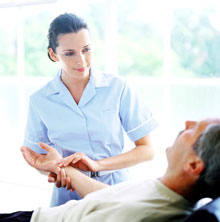
Getting the patient’s vital signs does not always need medical instruments. Some of them can be obtained through sensation and observation, just like the respiration rate and the pulse rate. In this type of examination, using of hospital or home medical equipment is not very necessary. As long as there is a properly functioning wristwatch or clock with a second hand, I can always obtain the accurate value for pulse and respiration of my patient. To get the pulse rate, what I do is to palpate the wall of radial artery using the tips of my two fingers (the index and middle fingers). The radial wall is found on the base of the thumb, with the hand out and the palm up. The number of pulsating beats that I accumulate within one minute will serve as my patient’s pulse rate.

Same as the pulse rate, the respiration rate can also be obtained without using medical instruments. To get the respiration rate, all I need is to look and count how many times the chest of the patient rise and fall within one minute. The rising of chest means the person is inhaling and the falling of chest means the person is exhaling. One inhale and one exhale sums up to one respiration cycle. In some patients, acquiring the respiration rate via chest is difficult. On situations like this, I observe the stomach instead.

  • Digg
  • Del.icio.us
  • StumbleUpon
  • Reddit
  • RSS